Ingredients
Starter
- scant ½ tsp (1.6 gm) active dry yeast
- 354gm lukewarm water
- 19gm sugar
- 5gm malt powder
- 117gm bread flour
- 95gm dark rye flour
Dough
- all of the above starter
- splash (~15gm) water
- ½ tsp (2gm) active dry yeast
- 340 gm bread flour
- 14 gm caraway seeds
- 11 gm (½ Tbsp) seasalt
- 11 gm (½ Tbsp) sunflower oil
Instructions
- In a medium sized bowl, mix the yeast with the lukewarm water. Whisk together until dissolved and creamy looking.
- Add the malt, sugar and flour and using a wooden spoon, stir together until it is smooth. This is pretty sloppy mixture. Leave this to rest while you get the rest of the ingredients ready. Can leave longer if you like. Original recipe person left this overnight.
- In a small bowl whisk yeast into tiny amount of water until the mixture looks creamy and set aside.
- In a largish bowl, mix together the flours, caraway seeds and salt.
- Spoon the yeast mixture on top of the starter. Then carefully spoon the flour mixture overtop of that. Cover the bowl and place it in a warmish no-draught area (oven with only the light turned on in winter; counter in summer). Leave it for 4 hours. Beranbaum notes that some of the starter might begin to ooze up through the flour mixture but not to worry if it does. Don’t worry if it doesn’t either.
- After the 4 hours is up, add the oil. Using a wooden spoon, stir everything together until the dough pulls away from the bowl and the flour is pretty much encorporated. Cover and set aside to sit on the counter for about 20 minutes.
- Turn the dough out of the bowl onto an unfloured work surface. Wash and dry the bowl. This prepares the rising bowl AND gets your hands clean.
- Without adding any extra flour, knead the dough until it is silky (about 10 minutes). Let your dough scraper (a spatula works) be your friend if the dough is sticking to the board. Keep scraping any dough that is on the board so the board is always clear. If the dough seems too sticky (this can happen with rye flour mixtures) add traces of all purpose flour. Add as little extra flour as you can.
- Put the dough in the clean mixing bowl. No need to oil the bowl or the dough!! (Beranbaum says to oil the bowl AND the top of the dough) Cover and allow to rise in a no-draught area (warm room temperature) until it has doubled.
- When the dough has doubled, you can either gently push the dough down or you can shape the dough. A good way to tell if the dough has doubled is to wet your finger and poke a hole in the top of the dough. If the hole fills up, it hasn’t risen enough. If there is a whoosh of air and the dough deflates a little, it has risen too much. If the hole stays in exactly the same configuration and the dough remains otherwise intact, it is ju-u-st right.
- If your kitchen is cold and it’s already rather late in the day when the dough has doubled, gently push the dough down, cover it and put it in the fridge overnight. Take it out the next morning and let it sit for an hour or so to bring it up to room temperature.
- Shaping: To shape the bread, turn the dough out onto a very lightly floured board. Divide it in two even pieces (eyeball the cut; it doesn’t matter if it’s exact). Gently, but firmly, pat each piece into a narrow rectangle. Fold each one like a business letter: the top third down to the middle and the bottom third up to the top edge. Roll like a jelly roll and seal the seam. Place them seam side down on a parchment covered peel. Cover with a clean tea towel and a plastic bag overtop. Allow the loaves to rise until they have almost doubled (about an hour and a half). To test, flour your finger and press gently on the edge – it should very slowly spring back. For comparison, try pressing early on to see how it quickly springs back when the dough has not risen enough.
- Baking: Twenty minutes before you are going to bake, put a breadstone onto the middle rack and turn oven to 450F. (If you don’t have a bread stone, you can bake the bread on a cookie sheet.)
- Just before putting the bread in the oven, use a wet serrated knife to slash the tops. Then spray the loaves liberally with water. Put the bread in the oven. Immediately turn the oven down to 400F. Bake the loaves for about 30 minutes until they are hollow sounding on the bottom. Turn the bread around once to account for uneven heat in the oven.
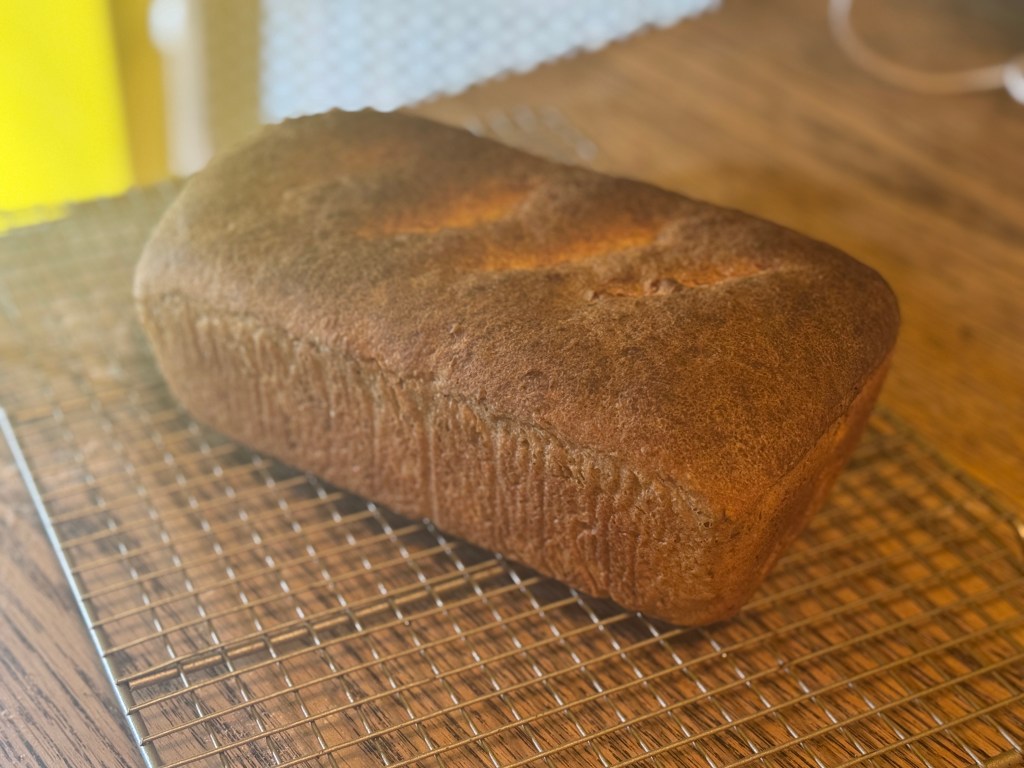
- Remove the bread from oven and allow to cool on a well ventilated rack. Wait til they are cool before cutting them. They are still continuing to bake inside!****
Adapted from: https://etherwork.net/blog/caraway-rye-bread-from-the-bread-bible/#recipe
(And The Bread Bible by Rose Levy Beranbaum)